
MixMate began as a small idea during my time as a trainee at the National Construction Academy.
Through wider industry exposure, site observations, and discussions with professionals, I became increasingly aware of a recurring issue: valuable time lost and avoidable errors arising from manual mix calculations.
MixMate was my attempt to solve that problem with something simple, practical, and reliable.
Who Am I, and Why Should You Listen to Me?
Before we go any further, let me introduce myself. I’m Sami Almutairi, a Civil Engineering graduate from NCA, but not just any graduate; I’m also a tech nerd with a background in cybersecurity. If you’re wondering what cybersecurity has to do with construction mixes, well, here’s the thing: both are about precision, problem-solving, and not making catastrophic mistakes.
Cybersecurity taught me how one tiny flaw can bring down an entire system; just like how one miscalculated mix can ruin an entire structure. So, naturally, when I saw how much time and effort construction professionals were wasting on manual mix calculations, I did what any reasonable person would do: I built a program to do it for them.
And that’s how MixMate was born: a digital solution to an old-school problem.
Why Mix Calculations Matter More Than We Admit
In construction, precision is not theoretical, it is structural. A small error in a mix ratio does not always show immediately, but it eventually reveals itself through cracking, weakness, or rework.
During my civil engineering training, this idea was reinforced repeatedly: most failures are not dramatic; they are cumulative. One incorrect calculation, repeated often enough, becomes a systemic issue.
Yet despite this understanding, mix calculations on the ground are still frequently done manually, sometimes from memory, sometimes from habit. I began to wonder why a task so critical was still so vulnerable to human error.
Developing MixMate While Training at NCA
MixMate was developed while I was still studying at NCA. The academy’s learning environment played a significant role; not by directing the project, but by creating the conditions where such an idea could take shape.
Instructors encouraged us to look beyond “how things are done” and instead focus on how they could be done better. Mentors were open to discussions that crossed traditional boundaries, and colleagues were quick to test ideas, challenge assumptions, and offer feedback.
With a background interest in technology, I started building a simple program that could handle mix calculations accurately and consistently. The goal was never to replace professional judgement, but to support it—by removing unnecessary repetition and reducing the risk of error.
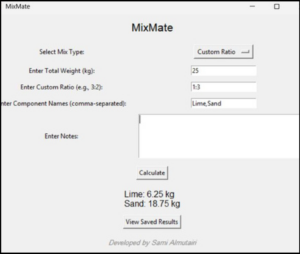
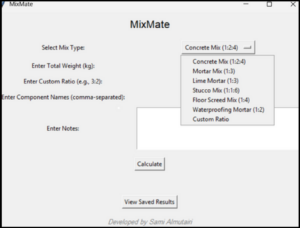
A Digital Solution to an Old-School Problem
MixMate allows users to select predefined mix types or enter custom ratios, input a total required weight, and instantly receive precise component quantities. What once required repeated manual calculations could now be done in seconds.
The tool reflects the same principles emphasised throughout my training: accuracy, efficiency, and accountability. It is not complex by design; it is practical by intent.
From Training Exercise to Practical Contribution
What started as a personal project during my time at NCA gradually became something more useful. MixMate demonstrated to me that meaningful contribution to the construction field does not always require large-scale innovation. Sometimes, it simply requires paying attention to everyday problems and having the confidence to address them.
That confidence was shaped during my training—through practical exposure, open dialogue, and an environment that valued initiative.
Building Smarter, Not Harder
As a graduate today, MixMate remains a reminder of an important lesson: working smarter often begins with questioning routines we take for granted.
Construction will always demand skill, experience, and effort. But it also benefits from tools that support precision and reduce avoidable risk. MixMate is one small example of how thoughtful training can translate into practical solutions—built not in isolation, but within a community that encourages growth.


 EN_GB
EN_GB  AR
AR